Gotham Knights
Show
2023
United States of America
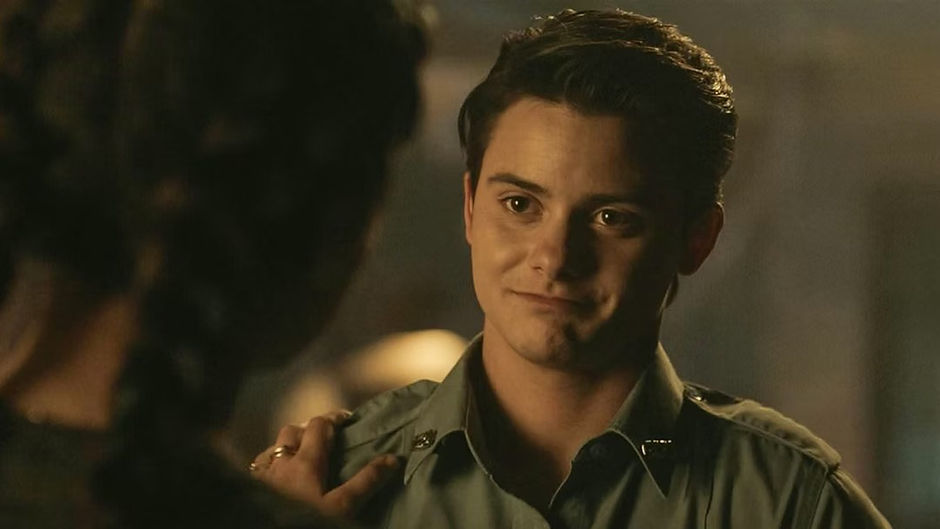
Cullen Row, a trans man played by American trans male actor Tyler DiChiara, is a superhero who works to clear his name after being arrested for the murder of Batman.
Available Summary:
In the wake of Bruce Wayne's death, his adopted son Turner Hayes forges an unlikely alliance with runaways Harper and Cullen Row, and the criminal Duela, when they are all framed for the murder by the Gotham City Police Department and District Attorney Harvey Dent. The four youths attempt to clear their names and find out who really killed Bruce Wayne, with help from Turner's friend Stephanie Brown and Turner's classmate Carrie Kelley, who is secretly the superhero Robin.
-Wikipedia.
Jack's Summary:
This show is exactly what you may think it'll be; it's a cheesy, predictable superhero series stuffed to the brim with conventionally attractive young adults. But, for all the flak this series got, it's no worse than other superhero shows I've watched, and the young actors offer decent performances. (In fact, the worst acting comes courtesy of Misha Collins, a veteran of procedural fantasy drama.) It's genuinely fun and engaging, once you get past the terrible pilot, which is common among superhero shows. As season 1 goes on, it gets better and finds its footing. At the time of writing, I'm up to the finale and am keen for its release.
Trans inclusivity doesn't automatically make any show or film good, as Relish (2019) proved when it sacrificed Tyler DiChiara at the altar of terrible writing and directing, but thankfully DiChiara has a better time in Gotham Knights. Would I call this show the pinnacle of its genre? Nah. But I do love the occasional unrealistic, ridiculous superhero show, and the fact that I can have that viewing experience with the added bonus of a trans male character, played by a trans man, is really nice. Gotham Knights is silly and fun. Given that I was most recently watching season 3 of the ironically-named Happy Valley, it's a relief to watch something that isn't depressing or painfully serious, and to have an trans male storyline included.

DiChiara plays Cullen Row, who is accompanied throughout the series by his sister Harper Row, a bisexual woman. The pair are thieves who are falsely accused of killing Batman, and team up with Batman's adopted son to clear their names and find the real killers.
The show establishes Cullen's trans male identity in episode 1, while he's being interrogated by police officers. It's a pretty stilted and rushed scene, as is the rest of the pilot, but it's not too bad. Ford, a minor character and an antagonist, is about to read Cullen's birth name aloud when Harvey Dent interrupts him, saying, "Don't use his deadname". The next reference to Cullen's trans status comes when he says he's determined to defend his name because he "chose the damn thing", and after that point the series only references his transition when fleshing out his and Harper's backstory.
Much of the time, and with every character other than Harper, Cullen is just a normal dude with other traits and hobbies, which I find really awesome. As the episodes go on, other characters are more thoroughly explored and Cullen is treated as a typical guy (extralegal skills aside). The only person who thinks about his transition is his sister.
The show does well to give Cullen personality beyond his transition. He's an artist too, and is repeatedly shown sketching in a notebook. He falsifies important documents, makes replicas of precious stones, impersonates a police officer, and steals cars during heists. He has a skillset and personality separate from being FTM, just like his sister has a skillset and personality separate from being bisexual.

Cullen is shown shirtless, which I really loved. The fact that young trans men can see themselves casually represented in such a way makes this show worthwhile. And the fact that the rest of his characterisation is good, without the kinds of scenes which have historically caused so much trauma to trans male communities, adds so much value to both Gotham Knights and Cullen.
In S01E05, Harper makes use of a mob connection, much to Cullen's shock as he was unaware that she ever dealt with mobsters. I absolutely loved a scene at the end of the episode, where Harper reveals that she got only involved with them in order to finance Cullen's mastectomy. "I could see how hard things were for you before the surgery," she explains, "We got away from dad, but you were still trapped. So, getting you that money was a no-brainer. And I would do it again." It's utterly adorable.

The show also has a fantastic lesbian/bisexual relationship, which made me so happy. It develops in a way which is really compelling. Stephanie's epiphany, when she finally experiences genuine attraction, was utterly wonderful and reframed several of her earlier comments about being romantically close with guys. I hope young lesbians are encouraged by her scenes and can recognise themselves in her. Stephanie's arc shows viewers that it's okay to embrace a lesbian identity after having had experiences with men, and that experimentation doesn't disqualify you from being gay.
Honestly, even without Cullen's storyline, I think Harper and Stephanie make this a worthwhile watch. The beauty of Stephanie's story is that she's not introduced as a lesbian, but rather, is assumed to be heterosexual and is making out with a guy in her first scene. Viewers are led to assume that Stephanie will be the love interest of either Turner or Brody, but neither is the case. Just because those two guys are attracted to her doesn't mean that she's attracted to either of them, which is how Gotham Knights set up a predictable romantic subplot and then defied it.
While Cullen's trans identity is established and then his other qualities are brought to the forefront, Stephanie's journey is inverse. She is defined by her intelligence, family situation, and loyalty before her lesbian identity is made apparent.
In terms of general themes, Gotham Knights has the following:
Violence typical in superhero shows (murder, combat, blood, light torture, hostage-taking, et cetera).
Consensual sexual interactions between people below the age of 18 (played by early 20s actors). No nudity or explicit visuals, but they are shown kissing and in their underwear.
A firearm suicide.
Misrepresentations of dissociative mental illness, complete with the classic smashed mirror motif. It isn't the worst depiction of dissociative mental illness out there, à la Split (2017), but it's nonetheless a depiction of "multiple personalities" causing a person to be violent and cruel.
Prescription drug addiction and alcohol addiction, particularly in relation to family dysfunction. A husband illegally obtains opioids in order to keep his wife addicted to pain medication. There is also general alcohol and drug use.
Discussions of extreme physical abuse, committed against a child by his father.
The kidnapping and physical intimidation of an elderly woman. She is evil, but regardless, if you're sensitive to depictions of elder abuse then you should proceed with caution.
Probably the only other note about Gotham Knights is that the most insufferable character is Turner, Batman's adopted son and ostensibly the main character. In that respect, this show is ploddingly consistent with other superhero series I've watched.
UPDATE:
I have now watched the finale, and am happy to report that no instances of needless misgendering or deadnaming need to be added to the list of warnings. All in all, Cullen's trans status is wonderfully irrelevant by the end of the season, and he instead plays a central role in evacuating a large area of the city.
The episode deals with the trolley problem on a city-wide scale, offers some more misrepresentations of what it means to have a dissociative mental illness, and ultimately offers a good launch pad for season 2. Unfortunately, it apparently hasn't been renewed, which is a genuine shame. I wanted to see Cullen's story continue in further episodes. Still, it's awesome that trans guys have this piece of representation in one season, and I'm glad DiChiara stepped up and took the role.
One reason I am glad Gotham Knights won't be renewed is the direction Harvey Dent took, which is similar to his classic origin story. I had hoped that, following the burning of his face, he would exhibit the same kindness, patience, and personality that he displayed throughout the majority of the season. That would be a great way to show viewers with facial differences that they can still be gentle and loved, even after being hugely changed by an accident/incident. A scene reuniting him with his child, perhaps in the hospital, would've allowed such a message. That wasn't what happened.
Instead, the show leans on characterising his dissociative state as "an evil twin riding shotgun in his brain", and makes his severely burned body the catalyst for effortlessly turning him into a monster. The dissociative state which existed to protect Harvey from an abusive father suddenly turns him into an unhinged murderer. The message that this sends to those with facial differences, and those with dissociative mental illnesses, is simple: You are evil. I had hoped that this show would do better.
To learn more about facial differences in particular, I recommend these links:
Facial Difference as Evil in Wonder Woman, written by the visible differences campaigner Carly Findlay.
And I highly recommend this interview with a young burn survivor:
I know I'm taking Gotham Knights very seriously here, and being quite critical of the show's demonisation of facial differences... But this really does matter. Being burned, injured, or born with a different face to most people doesn't make you evil or violent. In fact, such people are more likely to be the targets of violence and discrimination, on the basis of their appearance. It's long past time for media to give up on this outdated, nasty stereotype, because it has consequences.
And here is an interview with a woman who developed a dissociative mental illness due to childhood abuse:
Messaging in media, regardless of genre, impacts us all... and especially those of us who are vulnerable or visibly different.
Entry last updated:
8 Feb 2026