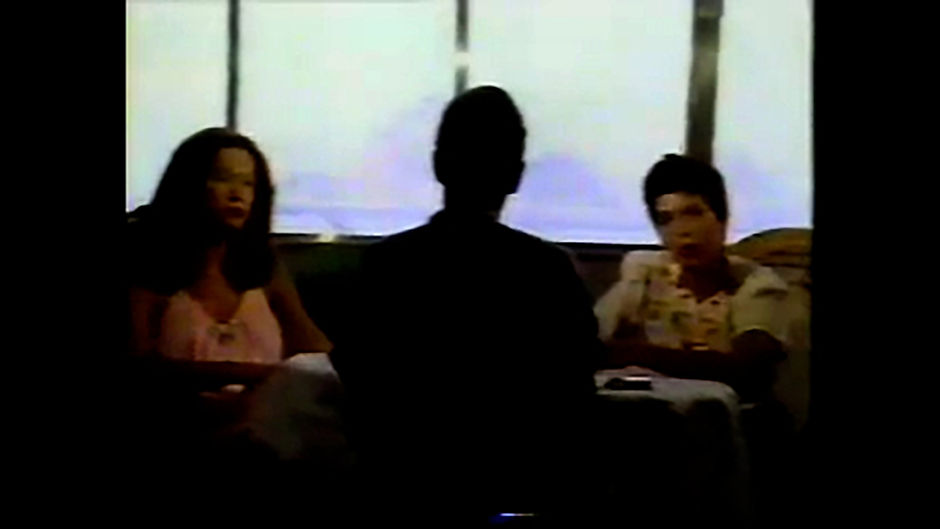
Entrevista com João W. Nery para TV Manchete (Interview with João W. Nery for TV Manchete)
Interview
1985
Brazil (Brasil)
Solange Bastos, a Brazilian journalist, interviews non-disclosing trans man João Nery alongside a transsexual woman. João was widely known as the first trans man to have undergone transition surgeries in Brazil. He was also Solange's brother, although this is not revealed in the interview.
Watch on YouTube.
Watch on Vimeo.
Related Thesis.
Available Summary:
Em [1985], essa reportagem no Programa de Domingo, na TV Manchete, foi a primeira matéria sobre transexualismo na TV brasileira. João W. Nery, hoje militante conhecido pelos direitos dos LGTB, não podia se identificar. Falou de costas, ao lado de uma transexual feminina, Joana. Antonio Houaiss conta por que resolveu prefaciar o primeiro livro autobiográfico de João, Erro de Pessoa. Ele é meu irmão.
In [1985], this report on the Sunday Program on TV Manchete was the first story about transsexualism on Brazilian television. João W. Nery, now a well-known activist for LGBT rights, could not identify himself. He spoke with his back turned, next to a trans woman, Joana. Antonio Houaiss explains why he decided to write the preface to João's first autobiographical book, Mistaken Identity. He is my brother.
-Familia Bastos Produções, Vimeo.
Jack's Summary:
The interviewer, Brazilian journalist Solange Bastos, introduces João by his first name only, and his face cannot be seen by viewers. Bastos reveals that João underwent surgery eight years ago (in 1977) and fraudulently obtained legal documents which reflected his male gender, and these are the reasons his identity must be protected. As Solange addresses João, neither sibling gives any indication that they are related. At no point is João's face seen.
Solange also introduces Joana, a trans woman and biochemist, and says that the interview team includes practitioners who support transsexual people. These practitioners must also have their identities hidden, she says, so that they can continue their work.
Antônio Houaiss is interviewed, and briefly discusses his decision to write a preface for João's book, emphasising the dignity and beauty of João's writing as being particularly compelling for him.
João talks about writing his book while recovering from surgery, and wanting to spark a wider discussion in Brazil about transsexuals being ignored and ridiculed. He emphasises that being a transsexual is not inherently the same as being a crossdresser or a homosexual. Joana, who is fully-disclosing as a trans woman in her workplace, agrees with João that transsexuals struggle in a regressive society, and that being visible as a trans person will help others be visible in the future.
After brief input from a practitioner who is sitting off-camera, João asks Joana about her choice to be visible whilst still being legally male and known by a male name. He compares this situation to his own struggle of obtaining a new legal identity; from what I can read in Não se nasce homem, torna-se by Caio de Souza Tedesco, João obtained a new birth certificate by pretending that he was a cis man who had never been issued one before, and so was re-registered as an entirely new person. This meant that he was considered uneducated and unemployable, and he had to start his life all over again, unable to refer to his qualifications and employment under a female name/identity. He wonders whether Joana is more courageous than him, and asks how she handles her situation.
In response, Joana says that she has faith that legislation will change to include and support transsexual people, and points to the legal decisions of other countries, which gives her hope. Joana says that she must find courage, that there is really no other option, especially since there are others in similar positions with less power and job security than she enjoys.
Solange points out to João that he lost his ability to practice as a psychologist, due to his transition. He confirms that, yes, he lost his history and résumé due to transitioning, but says that other paths opened to him. He worked as a taxi driver, a farmer, a house painter, and a street vendor, and feels more emotionally liberated than he had prior, even embracing his femininity to some degree.
Solange changes the focus of the conversation to religion and spirituality, revealing that Joana is a Catholic. In reply, João states that he is an atheist who believes only in the strength of human beings. After this, Joana notes that João seems happy. He agrees and says that meeting her is an emotional experience for him, as he has never spent long in the company of another transsexual before. The pair share details of their happy lives before Solange changes the topic, talking about the legal and medical advocacy which has arisen from João's transition.
Note from Jack:
I learned of João W. Nery thanks to Seu Franco!
Entry last updated:
7 Apr 2026